
Introduction
In the Sustainable Finance Taxonomy report, the introduction states:
Objectives:
The first phase of taxonomy development focuses on climate mitigation. Prioritizing climate mitigation reflects the urgency of reducing global greenhouse gas emissions and aligns with other jurisdictions, which focus on climate mitigation first.
This is disingenuous. The “urgent problem” is that 60 jurisdictions have introduced some kind of taxonomy and Canada is “potentially” losing out on foreign direct investment (FDI) because we don’t have one. Given that over half of the FDI into Canada is from the US with the 2nd place being 12% (UK) and 3rd place 11% (the Netherlands), and the US, our largest trading partner, isn’t doing any of this, this claim is absurd. Should Canada shackle its golden geese to eke out a few percentage points of foreign investment? Even if Canada were to get to net-zero or absolute zero, the effect on global emissions and global temperature would be negligible — it would be indistinguishable from the rounding error in the calculations of “global temperature.”
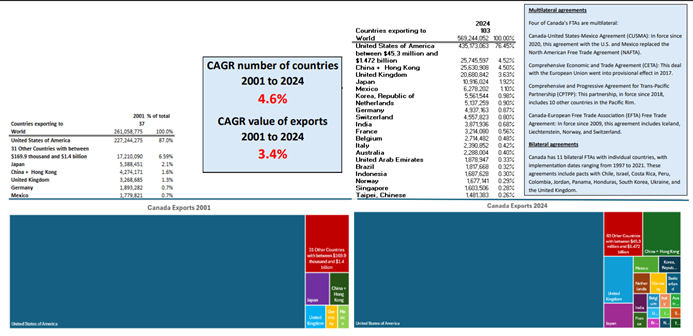
LINK to blog “Facts on Canada’s Global Trade – An Open Letter to Senior Deputy Governor Carolyn Rogers”
Canada-US trade. Note in the above image, over the course of 20 years, Canada did diversify its trading partners from 37 to 103, only to lose export value. The inclusion of this information is not to suggest we should not pursue additional markets, but simply to show that burdening Canadian industry with climate risk reporting and creating artificial taxonomies to attract investment in typically subsidized sectors will not help our economy or our relationship with our largest trading partner, the USA, which has abandoned climate ideology.
Is it Feasible? What is the Cost-Benefit?
Before expending time and money and public consultation to establish a framework that will impose significant burdens on industry and changes to society, one should evaluate the feasibility of the goal and provide a cost-benefit analysis.
The Business Future Pathways project for establishing Canada’s “Sustainable Finance Taxonomy” has not done either, nor has this large group of high-profile executives pivoted to integrate the dramatic geopolitical and scientific changes of recent weeks. National energy security – not climate risk – was recently exposed by events in the Strait of Hormuz as the highest priority for nations. By contrast, the rationale for assessing climate risk (i.e. under OSFI’S B-15 directive) has dissolved with the official retraction of the climate damage function paper used by the Network for Greening the Financial System (NGFS) known as Kotz et al. (2024), the official sidelining of the climate catastrophe scenario known as RCP 8.5/SSP5-8.5, and the exposure that the “Wedges” study from 2004 which claimed that humanity has the technology to transition off fossil fuels (i.e. wind and solar) and this can be achieved in incremental “wedges” has been shown to be untrue.
With these, the fundamental premise of the Paris Agreement has gone out the window. There is no climate emergency – but now there is a global energy crisis. Thus, the Sustainable Finance Taxonomy report focus on climate mitigation is misplaced and will lead to misallocation of vital investment funds necessary to REcarbonize Canada.
The stated purpose of the Business Future Pathways taxonomy group is to establish definitions of the types of industries or infrastructure that are climate-aligned with the 2015 Paris Agreement, according to categories defined as green, transition, or abatement.
The report states that, “Canada’s net zero target was established in response to the Paris Agreement and the 2018 IPCC Special Report on Global Warming of 1.5° C (IPCC 2018) and therefore provides a robust and credible level of ambition for the Canadian taxonomy.”
This science of IPCC’s SR 1.5 is woefully out-of-date.
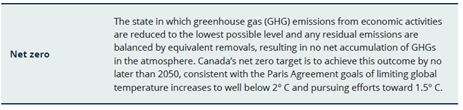
The Sustainable Finance Taxonomy report defines net zero as:
Continue reading in the PDF file;
The purpose of this taxonomy is not really about emissions reduction. Rather, it is trying to use non-governmental financial institutions as a mechanism of social control without going through parliament or any other democratic process.