August 19, 2026
See the PDF version for the cc list
ATTN: OSFI Superintendent Peter Routledge
Dear Superintendent Routledge,
RE: REcarbonize Canada! Sustainable Finance Taxonomy and OSFI must consider that Guideline B-15 is no longer justified by the evidence: US SEC proposes rescission of climate-related disclosure rules
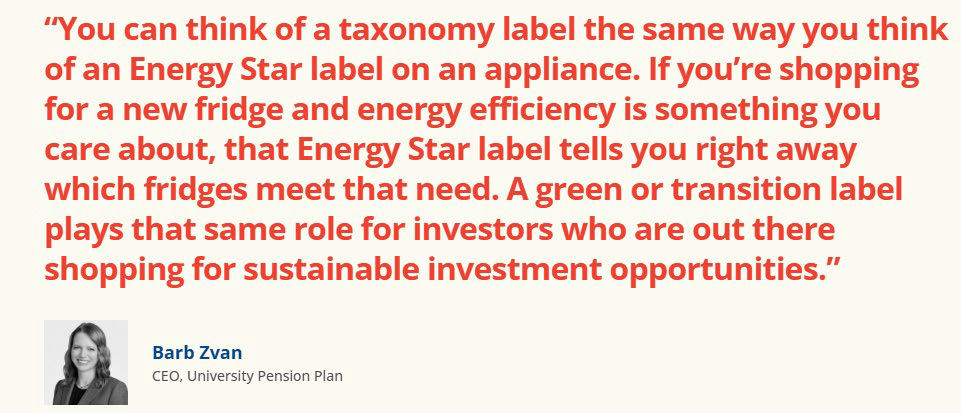
As you are aware, the Sustainable Finance Taxonomy group has issued their draft report, and it was open for public comment. As we mentioned in our last open letter to you, the Sustainable Finance Taxonomy group is relying on out-of-date climate science (the 2018 report known as IPCC SR 1.5). In our response to them, titled, “Sustainable Finance Taxonomy: Out-of-date Science and Unsustainable Greenwashing,” we noted that the categories they have laid out and the blind belief that Canada can reach net zero may be an inducement to fraud for investors.
Let us explain.
- The push for Net Zero relied upon the climate catastrophe scenario known as RCP8.5 (aka SSP5-8.5). The official climate modelling community that works with the Intergovernmental Panel on Climate Change (IPCC) has now deemed this scenario to be implausible and has abandoned its use. Most of the science referred to in IPCC SR1.5 was based on RCP 8.5, as is most of OSFI’s B-15 Climate Risk directive to all financial institutions in Canada.
- The economic climate catastrophe paper known as Kotz et al. (2024) was formally retracted by NATURE on Dec. 3, 2025. The Network for Greening the Financial System (NGFS) central banks drew their economic damage function for evaluating climate risk from this paper. Both OSFI and Bank of Canada are part of NGFS. Presumably, Kotz et al. has been reflected in economic climate damage functions in directives to Canadian banks (though we do not find specific mention of it in B-15, it may have been communicated or implemented in climate risk evaluations in other ways).
- The 2004 paper by Pacala and Socolow (2004), commonly known as “Stabilization Wedges” or “Wedges” that “argued that humanity already possessed all the technology needed to solve the climate problem well into the 21st century” has been shown to be false and compromised. As climate policy analyst, Roger Pielke, Jr. wrote this about whether we possess climate solutions technology: “We didn’t then and we still don’t today.” Pielke, Jr. is a highly accomplished individual, especially on the climate policy analysis front.
Thus, the alleged urgency and the case for net zero targets does not exist.
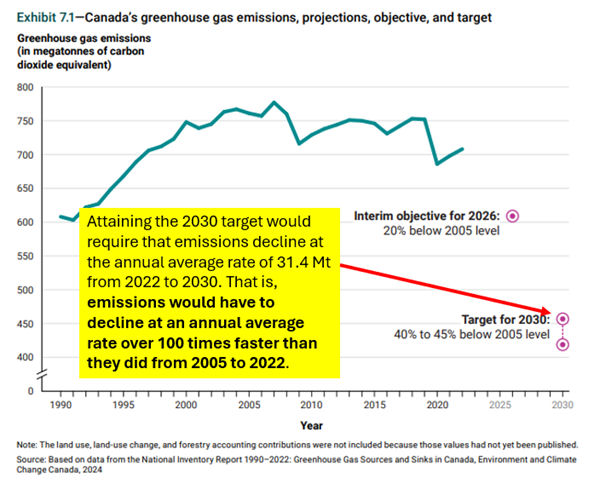
Furthermore, it will not be possible to reach net zero targets, despite Canada’s legislated mandate, as shown in the graph below.
THE ECONOMIC CASE FOR NET ZERO DOES NOT EXIST
The political case for pursuing net-zero policies rests upon the thesis that the countries of the world are committed to sharply reducing and eventually eliminating greenhouse gas emissions, largely by reducing consumption of hydrocarbon fuels and replacing them by zero-emission fuels.
The Energy Institute Statistical Review of World Energy is the most authoritative source of data on global energy supply, demand and emissions. In its 2026 edition, the review noted that fossil fuels (oil, natural gas and coal) provide 86% of the world’s energy needs. That percentage has been growing in recent years, not declining.
The review reported that consumption of oil was 100.6 million barrels of oil per day in 2025, the highest level in history. The rate of growth in global oil consumption has been over one million barrels per day per year, ever since 2012, with the exception of the pandemic years. This is the fastest rate of growth in history. Global natural gas consumption is at an all-time high (4,186 billion cubic metres in 2025). Global coal consumption is increasing and is now higher than in 2015. With respect to GHG emissions, the review reported that in 2025 the world emitted 35,806 million tonnes of carbon dioxide equivalent. In an allegedly decarbonizing world, this means that once again (as in almost every year since 1990) global GHG emissions have increased, this past year by 1.1%. Significantly, the non-OECD countries now produce 69% of the world’s GHG emissions. Almost all the growth in emissions is occurring in the non-OECD countries and especially in Asia. In short, most of the world’s countries continue increasing their use of oil, natural gas and coal because these are the energy sources that offer the best combination of economic benefits and security of supply for their growing populations.
Please continue reading in the PDF version.
Leave a Reply! Please be courteous and respectful; profanity will not be tolerated.