Questions, Questions, Questions.
Contributed by Robert Lyman © 2026. Robert Lyman’s bio can be read here.
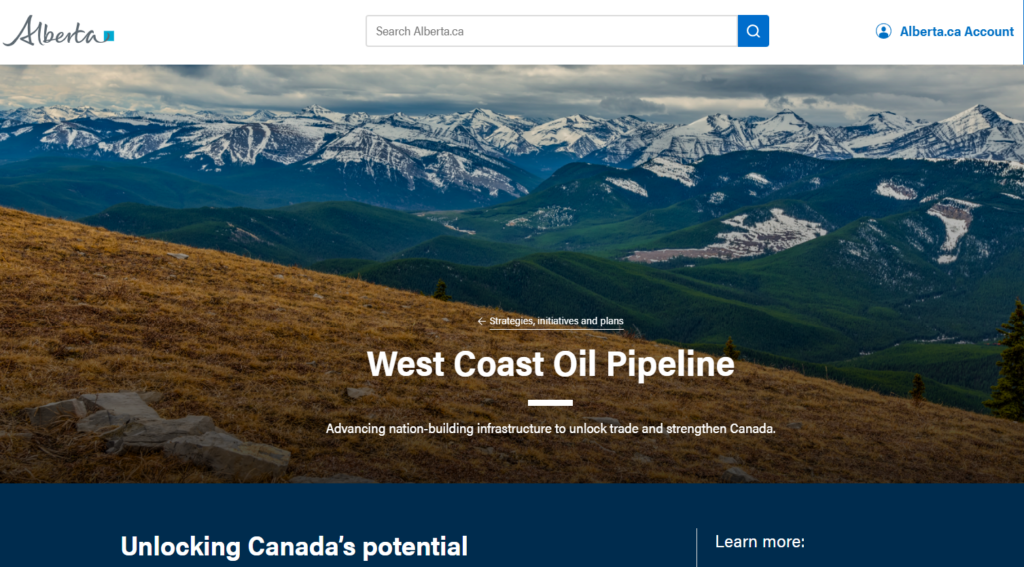
Under the current agreements between the governments of Canada and Alberta, it is anticipated that a proposal to build and operate a new oil pipeline to the British Columbia coast will be developed and, after regulatory reviews, perhaps approved. The exact process to be followed remains unclear. It needs to be understood better if the public and the engaged stakeholders are to have realist expectations about how events may unfold. This note offers some thoughts about that process and my personal projections about the dates by which each part of the process will be complete.
I acknowledge from the outset that there is great uncertainty as to the real intentions of the Carney government. Prime Minister Carney has had a long personal history of championing the view that climate change poses a catastrophic threat to humans and that a global commitment to eliminate greenhouse gas emissions should be a preeminent goal of public policy. There are many who argue that he has changed his views, that economic and trade objectives have now become paramount, and that he sees facilitating oil and gas development and transportation as more likely to gain votes. According to this view, Carney’s recent commitment to accelerate the review and approval of projects deemed to be “of national interest” is sincere and can be trusted. It is also argued that Carney sees a west coast oil pipeline as integral to his objective of diversifying Canada’s exports away from heavy reliance on the U.S. market. In short, “the world has changed” and Carney will be led or forced to change with it.
Others, of whom I confess to be one, do not concur that Carney’s policy goals have fundamentally changed, even though his tactics have, and he has demonstrated a willingness to compromise where it offers some political gain. The skeptics, if we may be called that, remember that the federal government continues to spend billions of dollars per year on emissions reductions and to implement the entire range of governmental actions to alter industry and consumer behavior, with little concern about their economic costs. The MOU between Canada and Alberta reduced industrial carbon taxes in the short term, but left them rising and likely to deter investment in the oil industry in the post-2030 period. The federal government has failed to rescind, or even amend, the moratorium on oil tanker movement off the coast of British Columbia.
No one knows for certain what Carney’s goals really are, and whether or not he will follow through on plans not only to hasten regulatory reviews, but also to facilitate the construction of the west coast pipeline. Against this background, what should one expect about the timeframe in which the West Coast Oil Pipeline will undergo review?
The project proposal has been developed only in general terms. A consortium including Trans Mountain Pipeline, the Alberta Petroleum Marketing Commission, Pembina Pipeline and eventually other sponsors will develop and submit a proposal to build a pipeline from near Edmonton, Alberta to a yet-to-be-constructed marine facility near Roberts Banks in southern British Columbia. The proposal has been submitted to the federal Major Projects Office.
The Major Projects Office will review the proposal to determine whether in its judgment the project meets the criteria in the Building Canada Act to be deemed a “national interest” project. The criteria to be assessed include whether and to what extent:
- The project strengthens Canada’s national resilience, security and independence;
- The project provides clear economic and other tangible advantages to Canada;
- It is probable in “statistical and practical” terms that the project will be successfully completed;
- The project respects, promotes, and advances the interests of the Indigenous peoples; and
- The project contributes to the attainment of climate change goals, environmental sustainability, and clean economic expansion.
If the Major Projects Office concludes that the project meets the necessary criteria, it will submit its findings and recommendations to the Hon. Dominic Leblanc, the Minister responsible under the Building Canada Act. The federal government has agreed that the recommendation should be made by October 1, 2026. (Prediction: the October 1, 2026 deadline will be met)
Minister Leblanc must consult with affected provinces, territories and indigenous rights-holders. He will take whatever additional advice he wishes and decide whether the criteria have been met. There is no deadline for his decision. It could be made a few weeks or months after the Major Projects Office has made its recommendations. (Prediction: The Minister decides sometime between December, 2026 and March,2027)
Assuming that the project is deemed in the national interest, it will then qualify for expedited review under the Impact Assessment Act and Canada Energy Regulator Act. The sponsors will have to carry out all the analysis and consultations needed before they will be able to complete a final submission. There is no way to know how long that will take, but based upon the recent history it could be a year or more. (Prediction: the final submission is made sometime between December, 2027 and April, 2028)
It is not clear yet to which body the final project submission will be made. It is reasonable to assume that the assessment body that will carry out the review will include both the Canadian Energy Regulator and representatives of other bodies such as the Impact Assessment Agency and the government of Alberta. Ideally, that assessment body would study the project in terms of its merits and acceptability under the Impact Assessment Act, the Canadian Energy Regulator Act and other relevant legislation. As the project will include both a land-based portion and a marine portion, there will be assessments of both. The assessment body must consider the following factors, among other things:
- The project’s likely effect on the environment, health, social or economic conditions, and public property, including accidents and cumulative impacts;
- The feasible options to prevent or reduce adverse impacts;
- Impacts on indigenous peoples and consideration of indigenous and community knowledge;
- The project’s contribution to sustainability and alignment with federal climate change commitments;
- The project’s purpose and alternative means or options for carrying it out;
- The project’s effects on socioeconomic factors such as community health, intersectional identity factors like sex and gender; and
- Comments on the project received from the public and local communities.
Based on the past experience of the Canada Energy Regulator and the Impact Assessment Agency, the assessment body would have to hold a large number of public hearings and conduct consultations with several different groups. It remains to be seen whether or not the same requirements for public consultation will prevail under a more “accelerated” regime.
It seems certain that environmental and indigenous groups will take measures to delay and prolong the assessment process, to raise public concerns about all aspects of the project and, if the opportunity presents itself, to challenge the results of the review process in the courts.
The duration of the review will be affected by the federal government’s proposed legislation to accelerate the review and decision-making concerning projects of national interest. The current proposals have a stated objective of achieving a federal decision within a two-year period, but what is meant by the beginning and end of that process is not specified. The federal discussion paper did not signal any changes in the requirement for public consultations, except to create a “consultation hub” to facilitate consultations with indigenous groups. The paper notably proposed that the federal assessment and permit reviews would be limited to one year, leaving one year for the federal government to conduct its consultations and reach a decision.
Imposing an arbitrary deadline on the duration of a project review process flies directly in the face of Canadian laws that grant regulatory tribunals broad discretion to govern their hearings, as circumscribed by their statutory mandates and common law principles of procedural fairness. Regulatory bodies have some discretion in this regard but cannot arbitrarily refuse to consider relevant information or limit the duration of testimony in such a way as to deprive participants of their right to be heard and to respond to the evidence of opposing parties. Any regulatory body that ignored these principles would risk having the Federal Court quash the hearing.
Thus, liming the initial review to no more than one year in length will be extremely difficult (if not impossible) to achieve due to the large number of issues to be considered and the large number of parties who will wish to be heard. Optimistically, the agency might complete its work within two-years but it would not be surprising for it to take at least three years. (Prediction: the assessment agency will report sometime between December, 2029 and October, 2030).
The report of the agency will go to both the Minister of Environment and Climate Change and the Minister of Natural Resources, who will review it in accordance with their responsibilities under the Impact Assessment Act and the Canada Energy Regulator Act. It is probable that these Ministers will take advice from their respective departments and from political advisors. Either one has the authority to deny approval of the project. It is more likely, however, given the designation of a project as being “in the national interest” that they would seek the approval of the federal Cabinet.
The time required for Ministerial discussions and reviews, for consideration and comment by central agencies like the Privy Council Office and the Prime Minister’s Office and for review and decision by full Cabinet is very difficult to estimate. It could vary from a few weeks to a few months. (Prediction: the Final Cabinet decision will be made and announced sometime between January, 2030 and December, 2030.)
Conclusion
There are many factors that would affect the timing of the review of the West Coast Oil Pipeline project that cannot now be known and assessed. The Carney government’s claim that the review and decision process will take only two years from the date on which the application for approval is filed may be credible if the federal government is genuinely determined to place higher priority on economic rather than climate concerns. Based on past experience, however, it seems unrealistic. It would not be unreasonable to expect a final Cabinet decision sometime in 2030, with construction of the project to commence some time after that. There are many decisions that the province of Alberta and the oil industry will have to make before the cabinet decision is made.
I would welcome the insights of others who may have first-hand experience of undergoing project reviews in Canada as to whether the timelines I have predicted here are within reason.
It seems to me that the government decision making process is so complex that a final decision to build is impossible. This pipeline to the west coast will never be built.