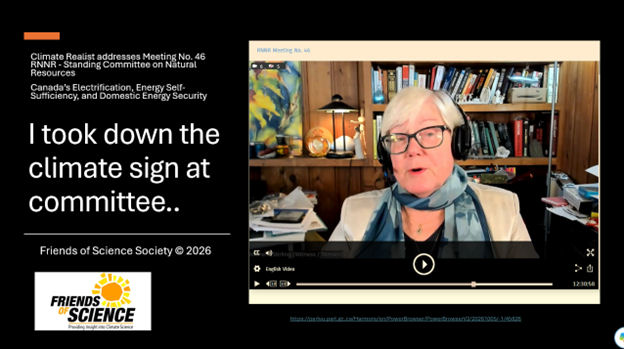
In a quirk of fate, Michelle Stirling, our Communications Manager, was invited to testify On Oct. 5, 2026, at the Meeting No. 46 RNNR – Standing Committee on Natural Resources Canada’s Electrification, Energy Self-Sufficiency, and Domestic Energy Security. In other words, a climate and energy realist was going to be sitting in a net zero-mandated room of parliamentarians. discussing “Power Canada Strong” – the national electricity strategy.
To add to the drama, two women from Environmental Defence were on the same panel as Michelle.
Since few members of the public are even aware that such committee meetings (on various topics) are going on all the time and thus are not informed of what their Members of Parliament are hearing, Michelle put together this power point and video explainer to walk through key items in her 5-minute presentation. She believes these visuals are important to help the general public and policymakers truly understand the implications of plans like “electrify everything” and “build a national east-west power grid” and “transmission lines” – or the promise that such a build-out with both provide more energy and reliability at a more affordable price.
Fundamentally, Canada and the US have a north-south power grid arrangement due to the economics afforded by the much larger population in the south, paired with our energy rich resources in the north. Unfortunately, Canada’s once abundant generation of electricity has evaporated, caused by population growth, drought and coal phase-out. Now Canada is a net importer from the USA – especially British Columbia.
The upshot of the video is that we must carefully think about our next steps in developing additional power generation in Canada. We need conventional, dispatchable (power that can be dialed up or down as needed) power generation; wind, solar and hydro dams are all weather dependent; batteries are useful for filling in rapid changes (like when the wind or sun drop off) but they are extremely limited in capacity. Batteries store, but do not generate power.
The premise of net zero and electrify everything is all based on the fear of a climate emergency – however, the catastrophic climate scenarios that drove this fear were recently retired from use as IMPLAUSIBLE but the official climate science community. We can go back to rational, common sense, energy systems planning. Here is the power point and additional resources.
You can watch the whole meeting here (Michelle appears at about 12:30:00)
MICHELLE’S SPEAKING NOTES (with clickable footnoted links): LINK
VIDEO EXPLAINER:
POWER POINT: LINK
KEY RESOURCES:
See our series of short videos with Randy Stubbings, P. Eng. (ret) on “Powering Canada Strong”: LINK
REPORTS:
What You Really Need to Know about Renewable Energy (That the Pembina Institute Won’t Tell You); LINK
The True Cost of Wind and Solar Electricity in Alberta: LINK
“Net Zero and the Future Power Grid; Examining Affordability, Reliability and Zero Emissions: LINK
In the Dark on Renewables: Rebutting Deloitte Insights and Climate Reality: LINK
In the Dark on Renewables – Video Overview: LINK
THE PURSUIT OF THE IMPOSSIBLE
Materials Constraints and Realities for the Net Zero Utopia: LINK
Assessing the US power system’s ability to support data center growth: LINK
Additional Resources by Kent Zehr, P. Eng. (which were not directly referred to in Michelle’s presentation to committee)
Why Renewable Energy Cannot Replace Fossil Fuels By 2050 (by Robert Lyman and Kent Zehr): LINK
Design Considerations of a Real-World Interprovincial Energy Corridor Transmission Line: LINK
False Assumptions: A Critique of Keller et al (2019) on BC Vehicle Electrification: LINK
Replacement of All Coal-fired Electricity Generation in the United States by Solar (PV) Power (from an Engineer’s Perspective): LINK
Electric Vehicle Considerations for Canada (2019 – before more stringent targets were introduced, thus making these issues of lack of power generation more critical): LINK
Other Tools:
Assess the solar insolation in your part of the world – Global Solar Atlas: LINK
Please support Friends of Science Society – join us or donate: friendsofscience.org
Fantastic presentation by Michelle!
Jeff in Uxbridge, Ontario