July 14, 2026
Office of the Superintendent of Financial Institutions (OSFI)
ATTN: Superintendent Peter Routledge
As in our many previous open letters to you, we request that you make a public statement regarding the dramatic exposure of misleading scientific and economic parameters that have been revealed in the past year. There are very real costs to individuals, corporations and society at large because of the misuse of climate scenarios in setting public policy.[1]
1. Recent Dramatic Changes to Official Scientific and Economic Climate Doctrines
Within the past year, there have been dramatic changes to the official scientific and economic doctrines on the impacts of human-induced climate change.
As each of these emerged, we have asked OSFI, several times, to issue a public statement.
- The ‘climate emergency scenario’ known as RCP 8.5/SSP5-8.5 has been sidelined by the official climate modeling community as implausible;
2) The economic catastrophe projected by the Kotz et al. (2024) paper was invalidated when the paper was retracted by NATURE;
3) More recently, the 2004 Stabilization Wedges: Solving the Climate Problem for the Next 50 Years with Current Technologies by Stephen Pacala and Robert Socolow has been revealed as having been mostly ghost written by British Petroleum, and that its claim that “humanity already possessed all the technology needed to solve the climate problem well into the 21st century” has been shown to be false.
As Bjorn Lomborg has pointed out, “Even after the world has spent $14
trillion on climate policy, more than four-fifths of global energy is still supplied by fossil fuels….”[2] Global Fossil fuel use increased by over 2.5% from 2023 to 2025.
2. A Recommendation to Abolish the European Union’s Emissions Trading System
In addition to the foregoing, it would be instructive for OSFI and its cadre of financial institutions, to review Prof. Emeritus Samuel Furfari’s detailed review of the ineffectiveness of the European Emissions Trading System (EU ETS) and why it should be abolished.[3] There are valuable insights for Canada’s finance sector, particularly as there is an effort to align with Europe by the Prime Minister and to institute Carbon Border Adjustment Mechanism (CBAM) policies in Canada. It should be noted that Furfari has had a seat at the table of climate and energy policies for decades, thus he speaks with clarity and deep understanding.
“Between 1982 and 2018, he was a senior official at the Energy Directorate-General of the European Commission, where he has devoted an entire career to energy technology and policy. He is a Chemical Engineer, having taught energy geopolitics and energy politics at Brussels ULB University (Université Libre de Bruxelles), between 2003 and 2021, where he also obtained his PhD, with a thesis in the field of energy.”
3. OSFI Directed Financial Institutions to use RCP 8.5 for climate risk analysis.
The Office of the Superintendent for Financial Institutions (OSFI) had instructed the financial institutions underits purview to use RCP 8.5/SSP5-8.5 (hereinafter RCP 8.5) as part of thefinancial community’s climate risk assessment.[4] Environment and Climate Change Canada, thePrairie Climate Institute, Infrastructure Canada, all relied on RCP 8.5 as the“business-as-usual” case. We now know (officially) that the scenario was implausible; many climate scientistsand economists knew this over a decade ago.4. Sustainable Taxonomy Draft Report Based on Implausible and Outdated Science
It is thus alarming to read that in the proposed Canadian Sustainable Taxonomy report of July 2026, they state:[5]To address these challenges, the Canadian taxonomy will be anchored in the ambition of the Paris Agreement, with technical screening criteria developed using Canada’s legislated target of achieving net zero emissions by 2050, enshrined in the Canadian Emissions Accountability Act (Government of Canada 2021). Canada’s net zero target was established in response to the Paris Agreement and the 2018 IPCC Special Report on Global Warming of 1.5° C (IPCC 2018), and therefore provides a robust and credible level of ambition for the Canadian taxonomy.
The 2018 IPCC SR1.5 report was largely based on the implausible RCP 8.5. We issued this rebuttal at the time explaining the issues with this implausible scenario: “Faulty Premises = Poor Public Policy on Climate”.[6]
Environment and Climate Change Canada issued their “Canada’s Changing
Climate Report 2019” (CCCR2019) in April of that year, which relied on RCP
8.5, and a climate emergency was declared by the Canadian government in June. We issued this rebuttal in May of 2019:
“Climate Change Your Mind.”[7]
Without the RCP 8.5 scenario, there is no climate emergency and no urgency.
Thus, the recently issued draft of the Sustainable Finance Taxonomy Methodology Report relies on outdated information.
The Paris Agreement and the IPCC SR 1.5 were predicated on RCP 8.5, the ‘climate emergency’ scenario. Thus, the Sustainable Finance Taxonomy Methodology Report taxonomy rankings cannot be valid.
5. Statistical Review of World Energy 2026 Shows an Increase in Fossil Fuel Use
As the Statistical Review of World Energy 2026 reveals, far from fossil fuels being stranded assets, its global consumption increased last year by 0.089% compared to 2024. However, its supply as a percentage of world energy supply changed in 2025 from 86.6% to 86.1%. Meanwhile, the total energy supply increased by 1.7% in 2025 over 2024. In 2025, wind and solar power combined still only provided 3.3% of the world’s energy, with all renewables excluding hydro providing 5.9%, according to the Statistical Review of World Energy 2026, summarized by retired energy economist Robert Lyman, and published by Friends of Science Society.6. So-called Climate-aligned Industries are Massive Consumers of Minerals and Energy with Large Embodied Emissions
Wind, solar, batteries and electric vehicles are not ‘climate-aligned’ as there has been no reduction in fossil fuels or emissions because of them; they have a much larger mineral requirement, meaning significantly more mining, more processing and thus more energy use; they have added as a complement to power generation in favourable weather conditions, but the Levelized Full Cost of renewables is significantly higher than conventional power generation. Likewise, they do not produce enough energy return on energy invested to support a hi-tech society, as Prof. Michael Kelly pointed out years ago.[8]
Continue reading in the PDF version.
Source:
IEA
7.
Humanity does not have
the Technology for the Net Zero Transition
Based on the abandonment of RCP 8.5, the
retraction of Kotz et al. (2024), and the revelation that the “Stabilization
Wedges…” report falsely claimed that we had the technology for the energy
transition, when that is not true, we believe it is imperative that you issue a
public statement on these material changes to climate and energy policy
drivers.
8.
Carbon Dioxide, if
doubled, will not Catastrophically Warm the Planet
Furthermore, the research work of
Professors William Happer and William van Wijngaarden show that carbon dioxide
is not like a big blanket, wrapping around the earth and choking the life out
of us (as is taught to most school children).
In simple terms, Professor
Happer explains that warming effect of increased carbon dioxide
concentration is like painting a barn red. The first coat of red
paint (i.e. first 400 ppm of CO2) has a noticeable warming effect,
but an additional coat of red paint (i.e. doubling of CO2) is barely
noticeable, and so on. More CO2, less warming effect.
9.
Canada’s Climate
Policies are Destroying our Economy
Canada’s obsession with restrictive climate
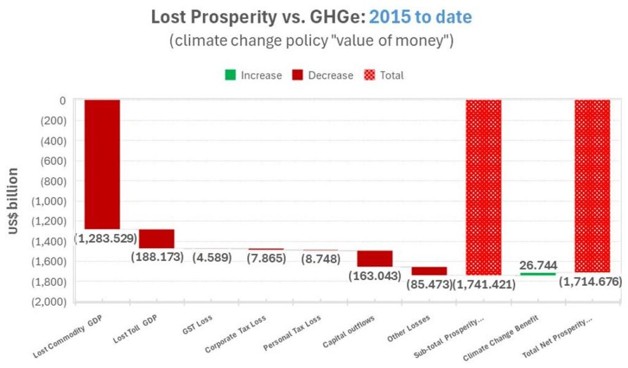
and Net Zero policies has led to massive 𝑪𝒖𝒎𝒖𝒍𝒂𝒕𝒊𝒗𝒆 𝑷𝒓𝒐𝒔𝒑𝒆𝒓𝒊𝒕𝒚 𝒐𝒑𝒑𝒐𝒓𝒕𝒖𝒏𝒊𝒕𝒚 𝒍𝒐𝒔𝒔𝒆𝒔 𝒐𝒇
~𝑼𝑺$𝟏.𝟕𝟒𝟏 𝒕𝒓𝒊𝒍𝒍𝒊𝒐𝒏 (𝟐𝟎𝟏𝟓 𝒕𝒐
𝟐𝟎𝟐𝟓).
This is based on the estimated economic loss that would have been forthcoming
due to the cancellation of large infrastructure projects (i.e. Keystone,
Northern Gateway and Energy East) and the effect of delays on a fourth project,
TMX expansion.[9]
10. Banks and other Financial Institutions must not Mislead or Coerce
Clients and Suppliers on Climate and Net Zero
As we have written you in earlier letters,
based on their Climate Action 2026 report and webinar, Royal Bank of Canada
(RBC) was planning a number of coercive Net Zero measures related to
interacting with their customers and commercial real estate landlords. They were planning to require Net Zero
targets/plans from customers or potentially drop non-compliant customers; for
their commercial real estate landlords, they were requiring the landlord to
commit within the lease to retrofit to Net Zero 2030 building standards, which
would materially drive up the cost of the lease to pay for the retrofits, for
no climate benefit at all. RBC (and probably other banks) were doing this to
comply with Net Zero directives from OSFI.
According to the Bank Act:[10]
False or misleading information
627.03 No
institution shall communicate or otherwise provide false or misleading
information to a customer, the public or the Commissioner.
Marginal note: Prohibited conduct
627.04 An
institution shall not, in its dealings in Canada with its customers and the
public,
- (a) impose
undue pressure on a person, or coerce a person, for any purpose, including
to obtain a product or service from a particular person — including the
institution and any of its affiliates — as a condition for obtaining
another product or service from the institution;(b) take
advantage of a person; or(c) engage
in any prescribed conduct.
A
great deal of harm is being imposed upon Canadian society due to these
ideological Net Zero goals for which the claimed scientific and economic
justification has vanished.
11. The IPCC Appears to be Engaging in Questionable Practises
It also appears that the Intergovernmental
Panel on Climate Change (IPCC) has not yet incorporated the revised climate
models (CMIP7) into their work as the new CMIP7 models will only be released in
September, yet the IPCC will be issuing a draft Working Group I (Physical
Sciences) report without them. How
reliable is this organization?
[1] https://open.substack.com/pub/rogerpielkejr/p/the-real-costs-of-implausible-scenarios?r=f96qu&utm_campaign=post-expanded-share&utm_medium=post%20viewer
[3] https://www.brusselsreport.eu/2026/06/16/the-case-for-abolishing-the-eu-emissions-trading-system/
[4] https://www.osfi-bsif.gc.ca/en/about-osfi/reports-publications/strengthening-climate-risk-financial-resilience-insights-standardized-climate-scenario-exercise
[5] https://www.businessfuturepathways.ca/wp-content/uploads/2026/07/canadian-sustainable-finance-taxonomy-methodology-report.pdf
[6] https://blog.friendsofscience.org/wp-content/uploads/2018/10/Faulty-Premises-Poor-Public-Policy-on-Climate-Oct-30-2018-FINAL.pdf
[7] https://blog.friendsofscience.org/wp-content/uploads/2019/05/Climate-Change-Your-Mind-FINAL-2.pdf
[8] https://www.cambridge.org/core/journals/mrs-energy-and-sustainability/article/lessons-from-technology-development-for-energy-and-sustainability/2D40F35844FEFEC37FDC62499DDBD4DC
[9] https://blog.friendsofscience.org/2025/10/17/facts-on-canadas-global-trade-an-open-letter-to-senior-deputy-governor-carolyn-rogers/
Leave a Reply! Please be courteous and respectful; profanity will not be tolerated.