
May 19, 2026
The Honourable Danielle Smith, M.L.A.
Premier of Alberta
Office of the Premier
307 Legislature Building
10800 – 97 Avenue
Edmonton, Alberta T5K 2B6
Dear Premier Smith,
RE: An Open Letter – Comments on the Canada-Alberta Implementation Agreement
Thank you to you and your team for all the hard work you have done to try and jumpstart a pipeline from Alberta to tidewater. Some goals were achieved.
That said, we have a number of concerns with the recent agreement.The US is Canada’s and Alberta’s largest trading partner. They do not have a carbon tax. The SEC is rescinding climate reporting rules,[1] while Canada via IFRS/CSSB is advocating for ever more stringent Scope 1, 2 and 3 GHG emissions reporting. This will decimate small businesses and agriculture, as we outlined in our “Integrity Matters: Mandatory Climate Reporting – A Risk to Society”[2] response to Catherine McKenna’s first report.
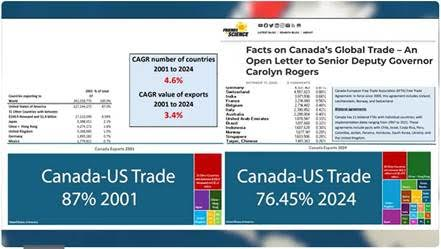
Source: Facts on Canada’s Global Trade – An Open Letter to Senior Deputy Governor Carolyn Rogers [3]
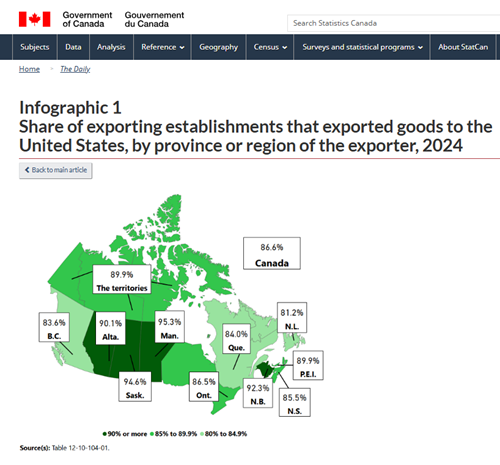
Source: StatsCan[4]
Climate Science Benchmarks have Changed Since COP26 and the Race to Net Zero
1) RCP 8.5 and SSP5-8.5 scenarios, formerly “BAU” dismissed as implausible
The concept of “Net Zero” gelled during COP26 in 2021, mainly as a consequence of climate modeling based on green house gas (GHG) emission scenario Representative Concentration Pathway 8.5 (RCP 8.5), which first gained prominence in 2014 with the release of the Intergovernmental Panel on Climate Change (IPCC) Assessment Report 5 (AR5). It was further modified and reissued as Shared Socioeconomic Pathway 5-8.5 (SSP5-8.5) with IPCC AR6 in 2021. Climate models of this scenario predict heightened, catastrophic, GHG-driven future warming. It was deemed to be the “business-as-usual” (BAU) case by the banking, finance, and insurance industries, by much of the science community, and by Environmental Non-governmental Organizations (ENGOs). In fact, this scenario is implausible and was recently acknowledged as such by the modelling committee that produced the scenario that was used by the IPCC and government climate agencies as the basis for climate policies and carbon taxes. Climate policy analyst, Roger Pielke, Jr., has a detailed discussion about this change and why it matters on his Substack.[5]
Continue reading the letter in the PDF version.
Leave a Reply! Please be courteous and respectful; profanity will not be tolerated.